

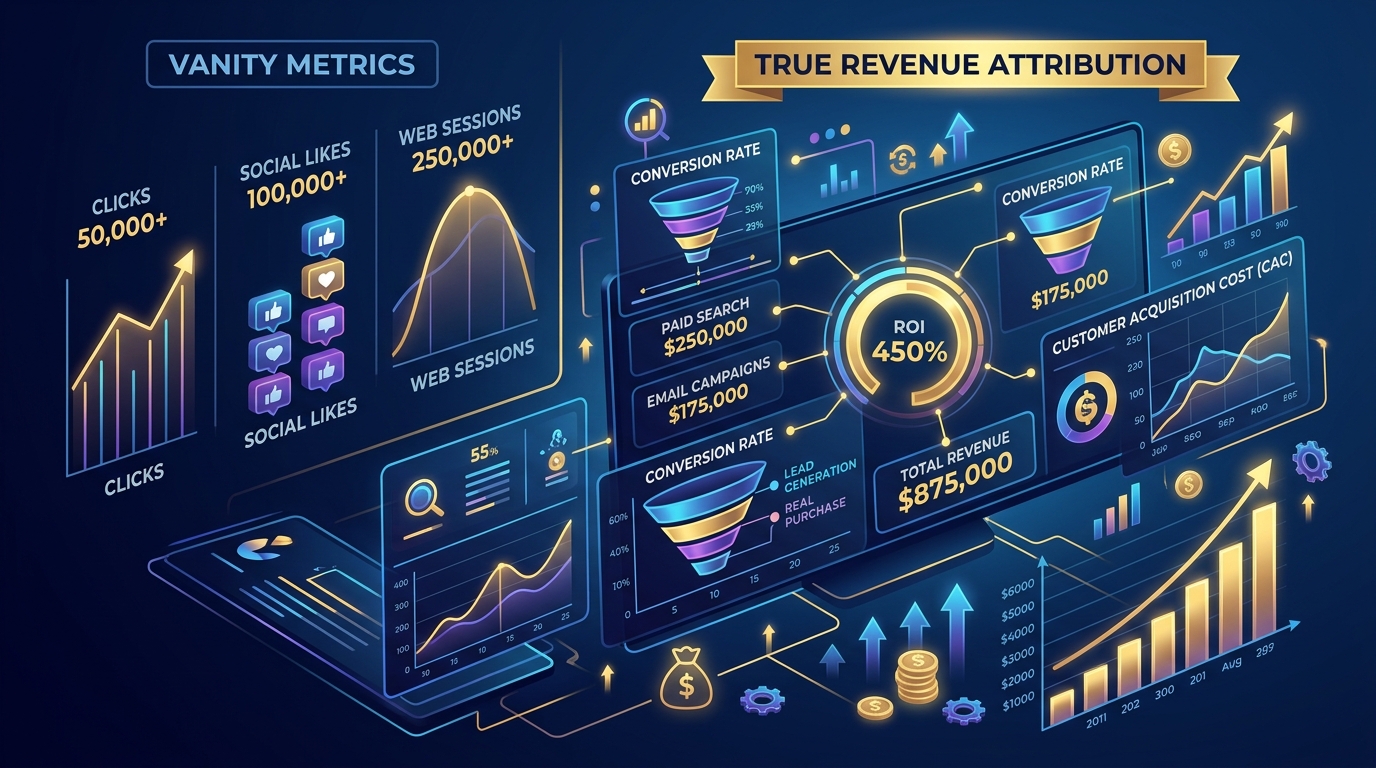
Picture the last marketing report you received. Chances are it opened with a big number: thousands of impressions, a jump in reach, a few hundred new followers. It felt good for about a minute. Then you looked at your enquiries, your calls and your sales, and the excitement faded.
If that sounds like your experience, you are in good company. Many business owners who hire a Digital Marketing Company Calicut has to offer, or any agency anywhere, end up in the same place, doubting whether the numbers they see have anything to do with the money they earn. Let's talk about why this happens, what the research says, and how tracking real revenue gives you a far more honest picture.
Everyone feels confident, few are actually measuring
Here is a number that surprised us. Nielsen's 2025 Marketing ROI Blueprint found that 85% of marketers feel sure they can measure return on investment. Yet only 32% look at traditional and digital media together to work it out. In other words, most people believe they have the answer while looking at only part of the question.
A 2025 practitioner survey tells a similar tale. About 64% of marketers keep an eye on revenue, but only one in four uses a clear method to measure the extra revenue their campaigns create, and 37% say they cannot isolate that impact at all. Meanwhile, the State of B2B Marketing 2026 study of 412 marketers found that 68% now call proving ROI their toughest challenge, compared with 40% just two years ago.
So the pressure to show results is rising, while the ability to measure them is lagging. That gap is where vanity metrics thrive.
So why do agencies keep sending them?
Honestly, it is not always dishonesty. It is convenient.
Ad platforms hand over impressions, reach and likes for free, so they take no effort to report. They also tend to rise whenever spending rises, which makes every report look like progress. And a page full of upward arrows rarely invites awkward questions in a client meeting.
The trouble is that these numbers can climb while your business stands still. Imagine a local clinic running ads that reach 200,000 people in a month. Sounds impressive. But if only a handful of those people book an appointment, the reach figure tells you very little about whether the money was well spent. Even cost per lead can fool you. A cheap enquiry from someone who never picks up the phone makes the report look brilliant and your sales look the same as before.
What revenue attribution means, in plain language
Think of it as following the money backwards. When a customer pays you, attribution helps you trace which ad, search, post or message first got them talking to you, and what that journey cost.
Setting it up usually takes three steps:
- Track every way people reach you, including website forms, phone calls and WhatsApp clicks, so each enquiry has a known source.
- Keep a simple record of what happens next. A CRM works well, and even a carefully maintained sheet can do the job, as long as each lead is marked as new, qualified or closed.
- Feed the outcomes back into your reports so you can see which campaigns brought paying customers, not just conversations.
Once that is running, your scoreboard changes. You begin to care about cost per qualified lead, cost per customer, revenue by channel, return on ad spend based on real invoices, and how much a customer is worth over time. These figures take more effort to collect, and that is precisely why they are worth trusting.
The leak nobody puts in a report
Here is something that has nothing to do with ads and everything to do with results. Speed.
A Harvard Business Review analysis of about 2.24 million sales leads found that companies who reached out within an hour were close to seven times more likely to qualify the lead than those who took longer. Another well known study from the Lead Response Management group found that the chance of qualifying a lead drops 21 times when the reply comes after 30 minutes instead of 5.
A report built on clicks will never reveal this. Revenue tracking does, because you can see exactly where enquiries go quiet between the first message and the sale. Very often the cheapest fix is not a bigger budget. It is a faster reply.
Why this matters even more when money is tight
Gartner's 2026 CMO Spend Survey puts average marketing budgets at 7.8% of company revenue, and 56% of the marketing leaders surveyed say they do not have enough budget to deliver their plans. The CMO Survey adds that when profits fall short, 53.1% of companies choose to cut costs before chasing growth.
Those samples lean towards bigger companies, but the lesson is the same, and often sharper, for smaller businesses. When every rupee counts, marketing that cannot prove its worth is the first thing to go. Revenue tracking is how you protect it, because you can show exactly which spend brought money back.
Five questions to ask your agency this week
You don't need to be an expert to test your current partner. Whether you are reviewing your existing team or speaking to a new Digital Marketing Agency in Calicut, try these:
- Can you show me what each customer costs, not just each lead?
- Do phone calls and WhatsApp enquiries get tracked as leads?
- Do you ever see what happened to the leads you sent us?
- Can the report show revenue by channel?
- When did you last suggest we stop a campaign?
Vague answers are a warning sign. Clear, confident ones suggest you are with someone who cares about your sales.
Choosing the right partner
Start with their reporting, not their portfolio. Ask to see a sample. If it begins with followers and impressions, think twice. If it begins with leads, customers and revenue, you are talking to people who understand why you hired them.
A good partner will also be upfront about what tracking cannot do. No model is perfect. A customer might see your ad on Monday, search your name on Thursday and call from another phone on Saturday. The best teams admit that, track what they can, and fill the gaps by talking to your sales team.
At Influocial Technologies, we believe any Digital Marketing Agency Calicut business owners choose should be judged by enquiries that turned into customers, not by numbers that simply look good. Reach and engagement still matter, but as clues on the road to revenue, not as the destination.
Final thoughts
Vanity metrics are not lies. They are just the wrong scoreboard. The research shows that confidence about ROI is common and proper measurement is rare, and that is where budgets quietly go to waste. Revenue attribution closes the gap. It asks for more setup, more honesty and closer teamwork between marketing and sales, but in return you get decisions you can explain with evidence.
If your reports look wonderful and your bank balance does not, it may be time to change what you count. Talk to the team at Influocial Technologies, and let's find out what your marketing is really earning.
"Vanity metrics are not lies. They are just the wrong scoreboard. Revenue attribution closes the gap. It asks for more setup, more honesty and closer teamwork between marketing and sales, but in return you get decisions you can explain with evidence."
Frequently Asked Questions
1. What are vanity metrics in digital marketing?
Vanity metrics are numbers that look impressive but do not show business results. Common examples are impressions, reach, likes, followers and page views. They tell you how many people noticed your brand, not how many became customers.
2. What is revenue attribution in simple words?
It is the practice of tracing each sale back to the marketing activity that brought the customer in. Instead of knowing how many people saw an ad, you learn which campaigns produced paying customers and how much each one cost to win.
3. Can a small business afford revenue attribution?
Yes. You do not need expensive software to begin. Tracking calls, forms and WhatsApp enquiries, and marking each lead as qualified or closed in a simple CRM or sheet, already gives you far more insight than a standard social media report.
4. Which metrics should I ask my agency to report every month?
Ask for cost per qualified lead, cost per customer, revenue by channel, return on ad spend based on actual sales, and lead response time. Reach and engagement can sit alongside them, but they should not lead the report.
5. Are impressions and followers completely useless?
Not at all. They help you understand brand awareness and audience growth. The mistake is treating them as proof of success. They are supporting signals, and they only matter when they connect to enquiries and sales.